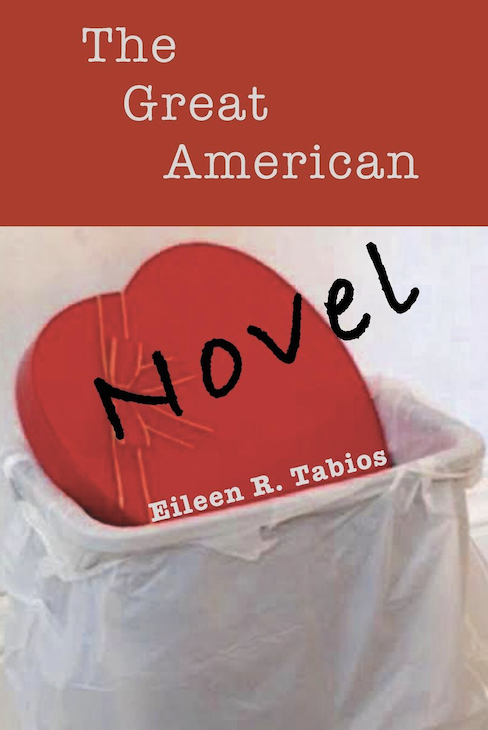
The Great American Novel: Selected Visual Poetry (2001-2019)
EILEEN R. TABIOS
Poetry
“[This collection] takes the reader on an extremely personal journey of exploration of cultural identity, the ramifications of colonialism, the functions of language and the possibilities of connectivity in love and pain where each poem acts as a poignant marker along the way.”
—Sacha Archer
ISBN: 9781732302570
LCCN: 2018955873
Publication Date: January 31, 2019
Paper | 6x9 | 130 pages
List Price: $18 (price may vary by retailer)
Praise
“With The Great American Novel: Selected Visual Poetry (2001-2019), Eileen Tabios not only presents 19 years of her forays into visual poetry, but takes the reader on an extremely personal journey of exploration of cultural identity, the ramifications of colonialism, the functions of language and the possibilities of connectivity in love and pain where each poem acts as a poignant marker along the way. Each sequence in this collection vastly differs—from asemic chance operations composed of Tabios’s plucked white hairs let fall into place (recalling how Duchamp composed 3 Standard Stoppages) to a description of each poem-object in a destroyed mail art correspondence of sculptural visual poems. Tabios’s openness to possibility has created poems radiating with life which are as heavy as they are celebratory. If you’re looking for bubblegum, move on—here is something entirely different for your eyes to chew on.”
—Sacha Archer
“’I write in Poetry…Poetry is its own language.’ In the work of Eileen Tabios this sometimes means crossed-out lines, removal of substance to discover other, deeper, substance, thus unearthing the real in a sequence of forgotten things, abstractions, thoughts, people, moments . . . the recovery of each deliberately formed, reformed, performed. She lives the reality and potency of visual and textual poetry with equal fluency, melding the two, bringing us to them as she brings them to us. Eileen Tabios is a human miracle of confident courage who invents and embraces the most difficult questions in rapid succession, and indwells in what erupts from each, demanding everything of the self within an infinity of other selves. By her being and her work, Eileen reveals that artistry at its most potent is self-aware. She embraces the stuff of life that might be art, and she erases the divide between discovery and invention. Eileen Tabios takes part by taking apart then seaming beyond seeming. Commas as visuals take form, flight, shape. Real lines of once alive things plucked from hair inventing poetry without genuflection. Achromotricia re(de)fines asemia, emerging a new version of whiteness against cloth backdrops. Finding poetry as poetry is. Eileen asserts in natural form the joining of worlds by being knowing learning doing becoming fascinated by what creates itself around her as she fascinates us by what she makes herself.”
—Sheila E. Murphy
“There is a close and multilayered connection between image and text in this book of Eileen Tabios’ selected visual poetry projects, from 2001 to the present. In some cases we have texts within the images, as well, and more than once they come from Tabios’ own verbal poetry. The images and their descriptions have a great influence on each other’s effect. I immediately got attracted to the first images, documenting an installation titled “Pilipinz Cloudygenous.” Then I read the notes, and went back to the images. The effect got stronger and stronger. While the mobiles of say, Fischli & Weiss, are about the funny chain of causality, Tabios’ work is about a funnily represented, rather absurd, but still functioning chain—leading back to the sources. “Hanging (from a ceiling)”, roots in the sky. In The Mortality Asemics series, I can see—and learn from the description: the two processes are always intertwined! —how eight strands of plucked out white hair transcend into a celestial constellation and, in a parallel fashion, into the “lines” of an asemic poem. In a similar sequence, titled The Outsider’s Dilemma, one hair falls apart from the others. It is doubly cut off from its source, and that is exactly why it, movingly, gets in the focus of the wordless poem. The title piece is a heart-shaped red chocolate box seeming to protest through its own theatrical presence against having been dropped into a waste bin. The heart is apparently too big to be fully hidden. The work dates from 2016. “Answers, as with the internet and diaspora, are not fixed but provided by its viewers based on their differing subjectivities.” See what you read and read what you see. Tabios’ wise and entertaining book reveals a multitude of contexts.”
—Márton Koppány
About the Author

Eileen R. Tabios loves books and has released over 70 collections of poetry, fiction, essays, and experimental biographies from publishers in 11 countries and cyberspace. Publications include the long-form novels The Balikbayan Artist and DoveLion: A Fairy Tale for Our Times; the form-based Selected Poems, The In(ter)vention of the Hay(na)ku: Selected Tercets (1996-2019), THE GREAT AMERICAN NOVEL: Selected Visual Poetry (2001-2019), INVENT(ST)ORY: Selected Catalog Poems & New (1996-2015), and THE THORN ROSARY: Selected Prose Poems & New (1998-2010); the first book-length haybun collection, 147 MILLION ORPHANS (MMXI-MML); a collection of 7-chapter novels, SILK EGG; an experimental autobiography AGAINST MISANTHROPY; as well as two books translated into French and three bilingual and one trilingual editions involving English, Spanish, Thai, and Romanian. Her award-winning body of work includes invention of the hay(na)ku poetic form as well as a first poetry book, Beyond Life Sentences (1998), which received the Philippines’ National Book Award for Poetry (Manila Critics Circle). Her poems have been translated into 11 languages as well as computer-generated hybrid languages, paintings, video, drawings, visual poetry, mixed media collages, Kali martial arts, music, modern dance, sculpture and a sweat shirt. Additionally, she has edited, co-edited or conceptualized 15 anthologies of poetry, fiction and essays as well as exhibited visual art and visual poetry in the United States and Asia.
